AI has become too good. And we have to change how we teach math in university classes.
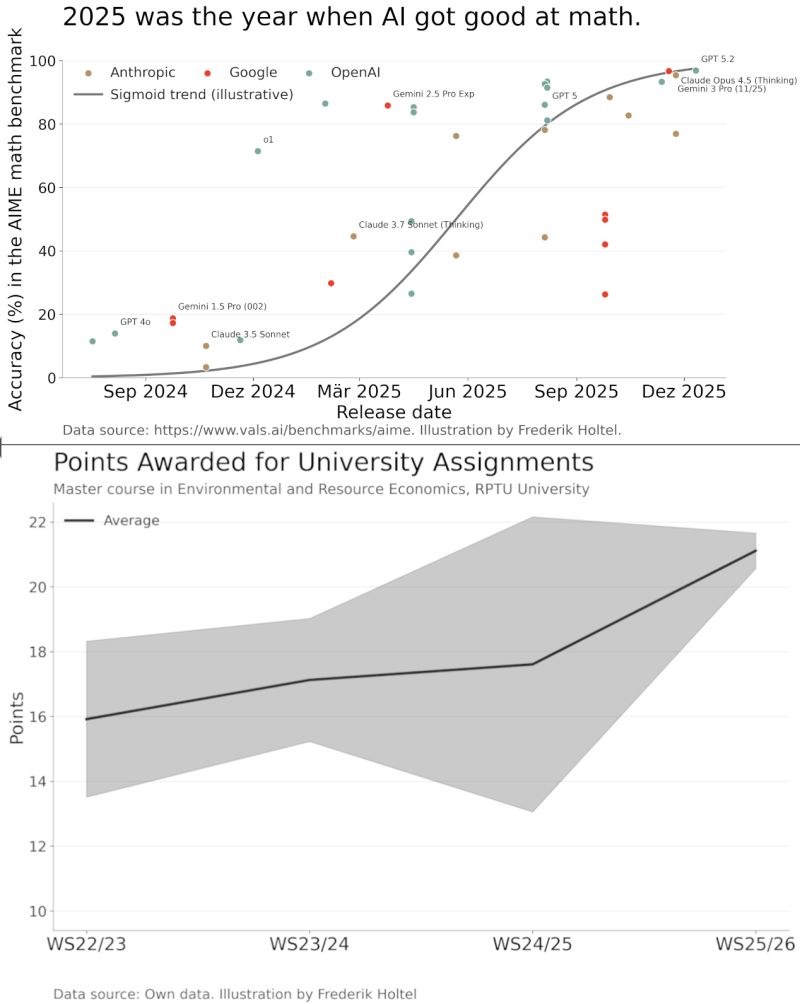
Two charts. Top: accuracy of AI models from Anthropic, Google and OpenAI on the AIME math benchmark by release date, rising along an S-curve from under 20% in late 2024 to about 95% by December 2025. Bottom: average points awarded for take-home assignments in the Master course in Environmental and Resource Economics at RPTU, rising from about 16 in WS22/23 to about 21 in WS25/26, with the steepest increase in the last year.
Top: AI accuracy on the AIME math benchmark (data: vals.ai). Bottom: points awarded for take-home assignments in our Master course (own data).

The top figure shows why. In 2025, AI systems crossed a threshold on advanced math benchmarks, moving from unreliable to near-expert performance within a single year.

The bottom figure shows the consequence. In our Environmental Economics Master courses at the RPTU University Kaiserslautern-Landau with Prof. Daniel Heyen, average scores of group work take-home assignments rose sharply at the same time. In contrast to a year before, students across groups suddenly submitted perfect answers. No wonder: by the end of 2025, ChatGPT was able to solve our math assignments flawlessly.

This is a huge problem for higher education. University grades are not just feedback for students, they are signals to the outside world over underlying candidate abilities. Once AI can reliably solve tasks, the signal breaks down (see signalling in economics).

Our ideas how to deal with this challenge

  1. Change the difficulty and workload

    Give students more and harder tasks per assignment.

    • Keeps students busy and exposes them to more problems
    • AI can still solve this
  2. Change the type of assessment

    Move from take-home assignments back to good old exams.

    • Standardised and fair
    • Boring, uncollaborative, and far from modern job tasks (“solve these 3 math problems in 90 minutes” 🙄)
  3. Change the nature of the assignments

    Ask students to create things for which they require AI, e.g. an interactive visualization or an app in two weeks.

    • Aligned with contemporary workflows and tool use
    • Tests different skills (computation skills rather than algebra)

No solution is perfect and we are currently using a combination of the above. Let me know what your thoughts are about this!